The Grand Egyptian Museum
Eternity meeting Modernity

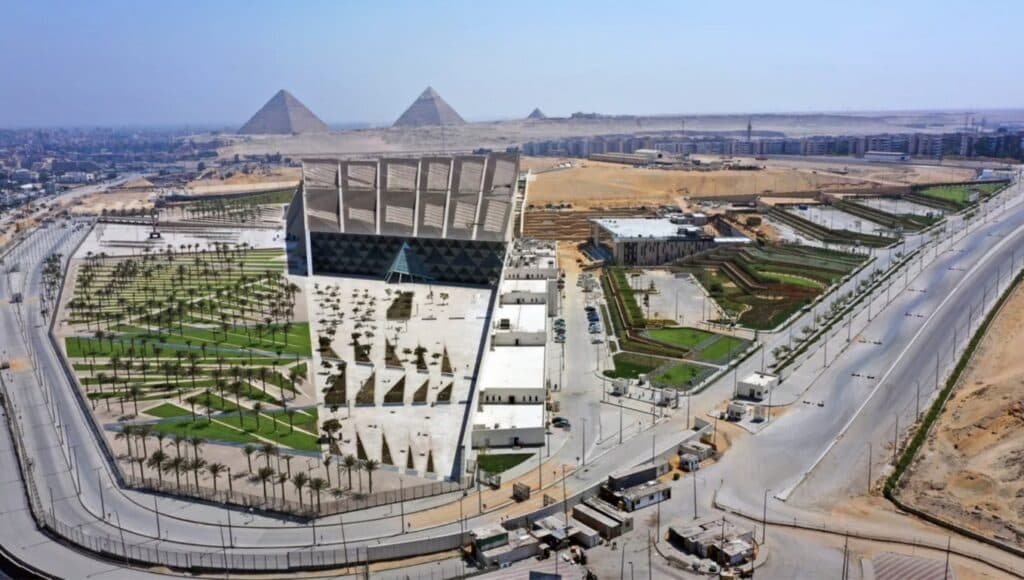
There are few sites on Earth where architecture must confront eternity. The Giza Plateau is one. Home to structures so old they predate written Greek, the pyramids have stared down empires, religions, revolutions and entire climatic eras. To build anything beside them is a provocation – how does contemporary architecture inhabit a landscape where the human hand has already done its greatest, oldest work?
Rising on the desert edge of the Nile valley, the Grand Egyptian Museum (GEM) isn’t simply a showcase for antiquities – it is architecture in conversation with millennia of history.
Designed by Heneghan Peng Architects, the building speaks in geometry, topography, light and orientation. It bows gently toward the majestic trio of the Giza Pyramid Complex and invites visitors into a passage of discovery and symbolism. The result is both deeply architectural and unexpectedly approachable – an elegant organism that holds the ancient and the present in a single breath.
The Ancient Lines That Still Shape the Land
Stand before the pyramids and imagine their edges extended across the desert like invisible beams. Those lines – Khufu’s north edge, Khafre’s diagonal, Menkaure’s taper – are the armature of GEM.
In the international competition, Heneghan Peng grounded their entire concept in triangulated geometry derived from the pyramids – projecting their orientations across the site and allowing them to structure the museum’s internal grid.
This is not metaphor. It is method.
According to the architects, these projected lines organize the museum into five triangular spatial bands, each following a specific visual alignment toward the pyramids. Walls pivot because the pyramids pivot. Courtyards widen because the desert geometry widens. Even the roof planes fold and tilt in sympathy with the ancient alignments.

Visitors feel this order instinctively. Spaces open where they should open and turn where they should turn. A building this large should be confusing. GEM is not. Its coherence comes from those extended pyramid lines – an architectural inheritance spanning forty-five centuries.
Carved Out of the Land, Not Placed On It
The museum occupies a site that slopes dramatically upward toward the plateau. Heneghan Peng’s competition proposal embraced this constraint as opportunity. Instead of fighting the topography, they have staged the visitor’s journey around it.

The building steps, folds and terraces in response to the terrain. The forecourt sits at the level of the Nile Valley – from there, the museum rises toward the desert horizon. You ascend almost without noticing – absorbed into a topographic choreography.
This isn’t mimicry of ancient construction – it is kinship. The pyramids were shaped from the desert and as such, GEM is shaped with the desert. The architects describe this as positioning the museum “between valley and plateau,” allowing the building to act as a threshold between two geologies.
The result is a museum that feels geological. You don’t walk into it – you walk through it, as if moving through layers of time.

The Alabaster Veil and the Egyptian Art of Light
Egyptian light is not something you simply block or admit. It must be negotiated with. The desert sun is merciless, ancient and architectural in its own right.
The mediator for this? An alabaster façade.
The architects describe GEM’s main desert-facing elevation as a monumental translucent stone screen – a contemporary reinterpretation of Egyptian alabaster. This isn’t a superficial gesture. The stone filters daylight, casting interiors in a soft, inhabitable glow “the color of dawn on limestone.”
For millennia, alabaster was used to channel light toward gods. At GEM, it channels light toward history.


The façade performs two tasks at once,
- It protects visitors and artefacts from harsh sun.
- And it ties the museum to a material lineage as old as the civilization it houses.
It is climate engineering as cultural memory.
The Grand Hall: Monumentality, Uncluttered
Other museums try to impress with sheer volume. GEM impresses with clarity.
Inside the main atrium, the 11-meter statue of Ramesses II stands at the center of a vast but remarkably composed space. The architects resisted the temptation to clutter the hall and instead, they describe it as a “grand void.”
Ramesses is given the silence he deserves.
Light that is filtered through the alabaster veil, illuminates him with a softness usually reserved for worship.

The geometry, structured by the pyramidal alignments, guides you toward the Grand Staircase – the museum’s great ceremonial ascent. The mood is ritualistic, but without imitation. It is monumentalism for the contemporary eye, being spacious, calm and gravitational.

The Hidden Engine of Preservation
Behind the galleries lies one of GEM’s greatest achievements – its conservation and research center. The architects describe it as a core programmatic element, deliberately integrated into the building’s structure rather than hidden.

Here – behind sealed corridors, stabilized temperatures, and material-specific labs – conservators handle wood, textiles, stone and metals of impossible antiquity. The full Tutankhamun collection is prepared and studied onsite. This is a museum that does not merely display objects – it actively prolongs their existence.
Architecturally, these spaces are quiet, controlled in an almost monastic manner. They are where the ancient past passes into the future carefully, scientifically and respectfully.
Cooling the Desert Without Gadgets
GEM does not flaunt sustainability. It embodies it.
Instead of relying on technological ornamentation, the building uses architecture itself through,
- strategic orientation to reduce solar exposure
- deeply recessed courts to create pockets of cool air
- thermal mass to stabilize internal temperatures
- landscape as a microclimatic tool
These approaches echo ancient Egyptian environmental wisdom – shade, shadow, stone, air and proportion. The architects describe this as “passive environmental control,” a design logic rooted in Egypt’s own architectural lineage.

The Landscape as a Bridge Between Two Worlds
West 8’s landscape design places the museum within a gradient between valley and plateau – exactly as the architects intended.
Planting palettes shift from lush to sparse, reflecting the geographical transition. Terraces articulate the rising terrain, shaded courtyards serve as cultivated oases and open plazas face the austerity of the desert.

Water elements – sparingly used – serve both aesthetic and climatic roles, cooling the air and reflecting sunlight.
It is landscape as mediator, not decoration – a bridge between two ecologies – two histories and two scales of time.

Movement as Storytelling
The greatest museums tell stories before you even enter a gallery. GEM tells one through light, ascent and alignment.

You begin in luminous spaces – bright, airy, valley-like. As you ascend through the museum’s five architectural bands (each aligned to a pyramid), the light softens, the scale tightens, the atmosphere deepens. By the time you reach rooms containing pigments, papyrus, jewelry and carved stone, your whole body has shifted into a more deliberate mode of seeing.
The architecture has prepared you for antiquity.
This isn’t decoration. It’s choreography – a spatial script shaped by the projected lines of three ancient monuments.
A New Voice Beside the Oldest Architecture on Earth
The pyramids are perfect. They do not need any interpretation, and they cannot be surpassed. What GEM offers instead is a companion form – something contemporary, confident, ground-conscious and reverent.
It is bold enough to stand here, but humble enough to acknowledge that Giza is already the world’s greatest architectural stage.
The Grand Egyptian Museum doesn’t try to add to that greatness.
It tries to understand it.
And then it lets you understand it too.
This is not just a museum.
It is Egypt – ancient, modern and evolving – translated into architecture.

References:
https://www.hparc.com/work/the-grand-egyptian-museum
https://www.bbc.com/news/articles/ckg4q403rpzo
Image Sources:
https://www.globalconstructionreview.com/egypts-grand-museum-99-complete/
https://al-fanarmedia.org/2025/10/grand-egyptian-museum-opens-this-weekend/
https://the-past.com/review/whats-on/a-first-look-at-the-grand-egyptian-museum/
https://www.researchgate.net/figure/Museum-Master-plan-Source-GEM-2018_fig2_350805093
https://www.youregypttours.com/en/egypt-tours-blog/the-gem-new-12-galleries
https://www.hparc.com/work/the-grand-egyptian-museum
Related Posts

Architecture Against the Storm
January 7, 2026

Street Markets as Designs
December 24, 2025

What Do You Want, and is it Possible?
December 10, 2025
How Traditional Sri Lankan Textiles Shape Modern Contemporary Interiors
November 12, 2025

City of Dreams
October 22, 2025

“From Dream to Reality” – The Sri Lankan Building Process
October 8, 2025