Architecture Against the Storm
Lessons from Cyclone Ditwah in Sri Lanka

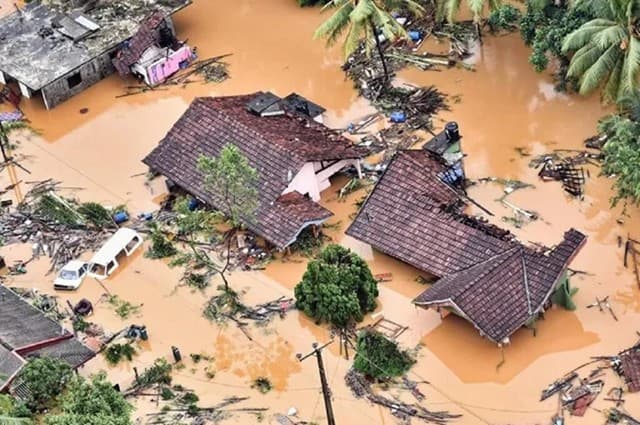
When Cyclone Ditwah swept across Sri Lanka in recent days, it did not discriminate by district or topography. Coastal towns flooded, inland river basins overflowed and the central highlands saw landslides carve through settlements that had long occupied unstable terrain. While the cyclone was a natural event, the scale of devastation was not inevitable. It was shaped – amplified even – by architecture, planning and the long-standing relationship between built form and landscape.
Architecture cannot stop cyclones. But it can decisively influence whether a storm becomes a humanitarian catastrophe or a survivable event.
The Myth of the “Natural” Disaster
Disasters are often framed as acts of nature, yet Cyclone Ditwah exposed a more uncomfortable truth – it is the built environment that transforms hazards into disasters. Low-lying settlements along floodplains, informal housing on steep slopes and dense coastal development without protective buffers all contributed to the severity of damage.
In many affected areas, houses were not destroyed by wind alone but by water, prolonged inundation, foundation failure and mudflow. These are architectural and planning failures as much as meteorological ones.
Siting and Settlement Patterns
The most consequential architectural decision happens before design begins – where we build.

In Sri Lanka, rapid urbanization and housing pressure have pushed communities into floodplains along major rivers, reclaimed wetlands, unstable hill slopes in the central region and exposed coastal belts stripped of mangroves. Cyclone Ditwah made it visible how architecture without geographic intelligence dramatically increases exposure to hazard.
This condition is not unique. In the Netherlands, repeated flooding forced a national shift away from defensive embankments toward a spatial strategy known as Room for the River. Entire settlements were relocated, floodplains were widened and land was deliberately surrendered to water. The architectural lesson was clear – resilience begins not with stronger buildings, but with strategic restraint – specially in where to (and not to) build.

For Sri Lanka, risk-informed siting – river setbacks, avoidance of landslide-prone slopes and preservation of natural drainage paths – can reduce disaster losses dramatically without increasing construction costs. Architecture must therefore operate as a territorial discipline, shaping settlement patterns as much as individual buildings.
Building Form and Structural Logic
Where relocation is not feasible, architecture must adapt.
Traditional Sri Lankan building knowledge already offers clues such as raised plinths and stilted floors, steeply pitched roofs that shed wind and rain and lightweight upper structures that reduce collapse risk. Yet much contemporary housing ignores these principles.

During Cyclone Ditwah, failures occurred at predictable points: roof-to-wall connections, shallow foundations, unreinforced masonry and sealed ground floors that trapped floodwater. These were not extraordinary failures, but consequences of everyday design decisions.
In flood-prone regions of Japan, residential architecture increasingly treats inundation as a design condition rather than an exception. Elevated living spaces, floodable ground floors, continuous load paths and materials selected for repeated wetting and drying allow buildings to recover quickly after floods.
Flood-resilient architecture does not resist water – it accommodates it. These are architectural decisions, not engineering luxuries.
Also in Japan, flood resilience extends beyond individual buildings into the section of the city itself. The Metropolitan Area Outer Underground Discharge Channel – a vast underground reservoir beneath the Tokyo region – temporarily captures excess river water during extreme rainfall, reducing surface flooding without altering the urban fabric above.

Though infrastructural in nature, the project demonstrates a critical architectural lesson: resilience can be embedded invisibly into the city’s depth. Buildings operate with the assumption that water is managed across multiple layers – landscape, infrastructure and structure – rather than resisted at the building envelope alone. Even at smaller scales, this sectional thinking offers valuable lessons for flood-prone urban areas in Sri Lanka.
Landscape as Infrastructure
The most effective defenses against flooding are often not buildings at all.
Mangroves, wetlands, paddy fields and urban green corridors function as living infrastructure – absorbing water, slowing storm surges and stabilizing soil. Cyclone Ditwah revealed that where these systems had been erased or constrained, damage was markedly worse.
Globally, this understanding has reshaped architectural thinking. In delta regions across Europe and Asia, landscape is no longer treated as decorative or residual space, but as a primary hydrological system that buildings must work with rather than override.

Architecture journals have long separated buildings from landscape. Ditwah demonstrates that this divide is no longer tenable. The most resilient architecture in Sri Lanka may not be a structure at all, but a restored mangrove belt or a preserved floodplain allowed to perform its ecological role.
Public Buildings as Lifelines
Civic architecture must be designed for continuity, not just occupation.

During Cyclone Ditwah, schools, temples, community halls and clinics became ad-hoc shelters. Many were not designed for this role, lacking elevated access, backup power, sanitation capacity and flood-resistant finishes.
In Bangladesh, a dense network of elevated cyclone shelters – often functioning as schools in everyday life – has transformed disaster response. These buildings are not exceptional, they are intentionally dual-purpose, embedded into daily civic life and ready to perform during crisis.

In a disaster-prone country, architecture has a civic obligation: every public building should be a safe building. This is not an emergency response issue – it is a design brief.
Reconstruction – A Dangerous Opportunity
Post-disaster rebuilding can either reduce risk – or reproduce it.
Reconstruction after Cyclone Ditwah is already under pressure from speed, cost and political urgency. History shows that when rebuilding prioritizes quantity over intelligence, vulnerability is simply reinstated.
Architects must resist the urge to reproduce pre-disaster forms and instead advocate for:
- risk-mapped housing typologies
- region-specific design guidelines
- hybrid solutions combining vernacular wisdom with modern detailing
- policies that treat resilience as a design quality, not an add-on
Disasters expose architectural failure – but they also open a brief window in which different futures can be imagined and built.

Toward a Culture of Architectural Resilience
Cyclone Ditwah should mark a turning point in how architecture is practiced in Sri Lanka. The question is no longer whether climate-driven disasters will occur, but whether architecture will continue to enable vulnerability – or begin to design against it.

The most resilient architecture is not heroic, monumental or expensive. It is context-aware, modest and landscape-driven. It acknowledges water, wind and soil as design partners rather than enemies.
In a warming world, architecture’s role is very clear – not to control nature, but to make human settlement humble enough to survive it.
References:
https://www.undrr.org/terminology/disaster-risk
https://www.mlit.go.jp/en/mizukokudo/index.html
https://info.undp.org/docs/pdc/Documents/BGD/00060069%20DRF%20TERMINAL%20REPORT.pdf
https://www.unisdr.org/files/53213_bbb.pdf
Image Sources:
https://island.lk/sri-lanka-and-global-climate-emergency-lessons-of-cyclone-ditwah/
https://www.researchgate.net/figure/Example-of-local-construction_fig4_265969433
https://www.nature.com/articles/s42949-024-00162-z
https://www.mdpi.com/2071-1050/13/10/5608
https://iiasa.ac.at/news/nov-2023/toward-resilient-recovery-after-disasters
Related Posts
The Grand Egyptian Museum
January 14, 2026

Street Markets as Designs
December 24, 2025

What Do You Want, and is it Possible?
December 10, 2025

How Traditional Sri Lankan Textiles Shape Modern Contemporary Interiors
November 12, 2025

City of Dreams
October 22, 2025

“From Dream to Reality” – The Sri Lankan Building Process
October 8, 2025