Tag: Deshan Kumar

Roofing Finishes for Sri Lanka
Clay tile roofing has long been the hallmark of traditional Sri Lankan architecture. The familiar terracotta tiles, often hand-molded and kiln-fired, lend a warmth and texture that resonate deeply with the vernacular aesthetics. Their heavy mass and characteristic gaps between tiles allow for natural ventilation, creating a cooling buffer that is invaluable in the hot, humid lowlands and the misty country alike. The pitched roof with generous overhangs effectively sheds the heavy monsoon rains while protecting walls and openings. Yet, this beauty comes with structural demands – supporting clay tiles requires good timber or steel rafters, and their weight and fragility necessitate skilled installation and ongoing maintenance. Greenery invasion or occasional breakage in high-rain areas mean owners must be vigilante to preserve their roof. Despite these challenges, clay tiles remain unmatched for projects that seek to blend tradition, climate responsiveness and timeless aesthetics.
Beyond the Spotlight
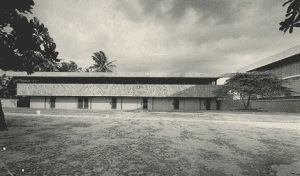
Geoffrey Bawa, the celebrated Sri Lankan Architect is known for his works centers around Tropical Modernism. While many of his works are well known and highly celebrated, some of his profound projects do not stand on that pedestal. They rarely make it to magazine covers or serve the curated sunset views. Some sit quietly behind school walls, some sit by calm lakes and some sit on edges of industrial or commercial fabric, woven into rhythms of daily life. Yet these works also celebrate spaces like any other of Bawa’s work: Corridors are not passages but slow transitions, courtyards hold not grandeur but pause, and walls that connect indoor and outdoor. This article dives into five such projects which are the lesser-known whispers.

Taming the Tropics with Concrete
Post-independence Sri Lanka’s architectural landscape was shaped by nationalist and tropical regionalism, and Architect Valentine Gunasekara’ modernist works were marginalized as anti-thesis for the former. Rejecting traditional forms, he embraced spatial fluidity, often experimenting with materials like glass and reinforced concrete, advocating for redefined outward reaching designs. His work can be understood as an attempt in exploring new spatial possibilities through modern materials, addressing the needs of Sri Lanka’s emerging middle class with modernist forms. He disliked the perpetuation of what was interpreted as elite forms and aesthetics in traditional manors and colonial bungalows.

Blame the Chair, Not Your Back
It is common to experience sore back, stiff neck or aching legs after a long workday, where all the blame is dumped on age. But it may not be the aging body alone, but it could be bad posture caused by furniture. The way we sit, sleep and work are heavily influenced by the design of the furniture we use. When they fail to match our body’s natural form, discomfort and health issues arise. The key to solving these problems lies in Anthropometry, the science if human body measurements. There is no specific size that it going to suit everyone. Therefore, by ensuring furniture dimensions to suit our body structure, we can improve posture and enhance comfort. Customizable chair and desk heights based in personal measurements lead to more productive and comfortable usage.

Minette De Silva
After years of struggle Sri Lanka was embracing decolonization after gaining independence from British rule during the mid-20th century. This was reflected in many aspects of daily life and Architecture and built environment was also in a phase of reviving and rejuvenating of traditional identities. Minette De Silva was one architect who played a significant role in Sri Lankan Architecture during this period. Having studied and worked in India and London she was also a modernist at heart. This fusion led to a practice blending local materials, techniques and artisanal traditions with the principles of modernism. This article discusses five significant projects handled by Archt. Minette De Silva during this transformative period.

DEMOCRACY or ELITISM?
The Parliament of Sri Lanka designed by the celebrated Architect Geoffrey Bawa is the political and administrative hub of the country. Architecturally it is an attempt to blend modernism with traditional Sri Lankan Architecture. The story behind designing and building the parliament itself is intriguing, with political imperative, contextual challenges, architect’ vision and controversies.
Designing your ‘Living Room’
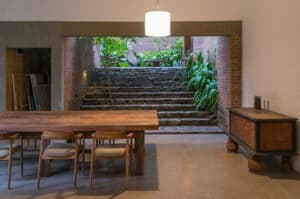
The Living room is where you unwind after a hectic day to watch TV, socialize, read, entertain friends, etc. It serves as a multifunctional space and the central gathering space of the home. Therefore, when designing such a space focus should be given to the balance in comfort, practicality and aesthetics in creating an inviting space.